To really hit up your cardio, muscular strength, endurance, and power, jump squats are effective and quite the challenge!
Muscles Used
-Quadriceps
-Hamstrings
-Glutes
-Calves
-Core/Abdominals (balance)
Daily Use of Muscles
-Jumping (obviously)
-Running/walking/ going up/down stairs
-Kicking
-Sitting/standing
-Coughing/laughing
Things to Remember
-Be sure to keep your back straight, pulling your belly button into your spine
-To save your knees and really work the appropriate muscles safely, keep your weight in your HEELS! Do no let your knees go past your ankles/toes; on the contrary, when you squat try to bring your toes off the floor
-You can either use your arms for momentum or to make it harder, bring your hands behind your head
-Breathe!
-Try 3 sets of 8-10 jump squats
Jump Squats
(thoughts on why this is the prisoner jump squat? ha)
Plyometrics are hard but fun because it requires you to use your body weight while doing challenging movements. An exercise that is known as being plyometric means that the muscle is being stretched before it is being shortened (worked).
This form of a push-up involves plyometrics because of the falling and pushing motion. Try out it and see what you think!
Muscles Used
-Pectoralis (chest)
-Core: abdominals, obliques, mid/lower back
-Deltoids and trapezius (shoulders and upper back)
-Biceps and triceps
-Hamstrings
Daily Use of Muscles
-Reaching/pulling/pushing
-Laughing/coughing
-Throwing/catching
-Kicking/walking/running
-Sitting/standing
Things To Remember
-This exercise is meant to do with a partner; if you don't have a partner, do what the girl does in the video by just changing your hand position
-Keep hips in line with the body; refrain from sticking them out or letting them sag
-Refrain from letting your head drop or turn; try to keep it in line with your spine
-Keep hands directly below shoulders
-Be sure to pull your belly button into your spine for stability
This exercise is wonderful for your inner thigh muscles. It also helps keep your lower body and core muscles in check by giving them extra support. Hint: this is also a great exercise if you are pregnant!
Check it out, and try it out!
Muscles Used
-Gracilis
-Sartorius
-Pectinius
-Adductor longus, brevis, and magnus
-Quadriceps (slightly)
Daily Use of Muscles
-Walking
-Running
-Kicking
-Standing
-Sitting/squatting
Things To Remember
-be sure to lean slightly back, but not too far back, on your stabilizing leg
-remember to flex your foot (bringing your toes in to your shin) and lead with your heel
-let your head rest on your arm; do not strain your neck
-notice in the video, the person's other leg is crossed over the working leg; you can do either position, whichever is more comfortable to you
-do not lift it too far off the ground; it's not a very big movement
One of the things that makes me dislike the plank exercise is how boring it is. Staying in one place, holding yourself up, for seconds to minutes at a time is aggrevating! However, this dynamic plank puts a little twist to the basic plank, challenging your upper body and core's muscular endurance. Not so boring anymore!
Muscles Used
-Pectoralis (chest)
-Deltoids and Trapezius (shoulders and upper back)
-Biceps and triceps
-Latissimus dorsi ("bra fat")
-Rectus Abdominis
-Obliques
-Erector spinae (mid-lower back)
Daily Use of Muscles
-Pushing/pulling
-Holding something/picking something up
-Carrying groceries
-Reaching for something
-Driving
-Laughing/coughing
Things To Remember
-Keep your hips in line with your body; try not to stick them out or let them sag
-Looking at the floor will help keep your neck in line with your spine; refrain from looking ahead or to the side
-For beginners, start out on your knees, then slowly progress to your toes
Since Monday was Memorial Day, I'm keeping with the "military" theme for the workout today! I've got two moves, one strength and one cardio, that I found on military.com that will get your heart pumping and your arms and legs burning.
Get to it!
Dumbbell Split Squat (with optional bicep curl)
Holding a pair of dumbbells with your arms hanging at your sides, stand in a staggered stance, your right foot in front of your left. Keeping your torso upright, lower your body until your front thigh is parallel to the floor. Raise yourself back up into the staggered stance and complete a total of 8 repetitions. Switch legs and repeat. For a more advanced workout, do a bicep curl when lowering into the split squat.
Muscles Used
-Quads
-Hamstrings
-Glutes
-Calves (slightly)
-Soleus (slightly)
-Core (slightly-for balance)
-Biceps (if doing a bicep curl when squatting)
Daily Use of Muscles
-running/walking/skipping/jumping
-going up/down stairs
-reaching/picking something up or lowering to ground
-sitting/standing
Things To Remember
-Be sure to keep your weight in the heel of your working leg
-DO NOT let you knee go past your toes
-DO NOT lunge forward; instead, lower straight down
-BREATHE
-For better balance, pull your belly button into your spine
Dumbbell Split Squat
Video of Dumbbell Split Squat
Cross-Body Mountain Climber
Assume a pushup position, your body forming a straight line from your head to your heels. Brace your abs--you'll hold them that way for the entire exercise. Now pull your left knee as close as you can to your right shoulder, without allowing your hips to sag. Return to the starting position and repeat, this time raising your right knee toward your left shoulder. That's 1 rep. Complete a total of 10.
Too easy? Try it with your feet on an elevated surface.
Muscles Used
-Pectoralis (chest)
-Biceps/Triceps
-Deltoids and Trapezius (shoulders)
-Abdominals and core
-Hip flexors
-Quadriceps
-Glutes
Daily Use of Muscles
-Pushing/pulling
-Walking/running
-Going up/down stairs
-Reaching up high/picking up off the floor
-Washing hair
-Driving
Things to Remember
-DO NOT let your hips sag or push up into the air-keep your body in a straight line!
-Breathe!
-Keep elbows slightly bent
-Keep neck in line with the spine by looking at the floor
-If this is too hard, start on your knees (but be sure to use padding under your knees!)
Working the core, upper, and lower body, this exercise is excellent. It also challenges your balance!
This is also a phenomenal exercise when it comes to being pregnant. It targets many muscles that will be used during labor and childbirth, and it also helps strengthen those areas where women tend to be weaker.
Have fun!
Muscles Used
-Pectoralis (chest)
-Shoulders (deltoids)
-Biceps
-Triceps
-Abdominals and upper, mid, and lower back
-Glutes
-Hamstrings
-Quadriceps
Daily Use of Muscles
-Walking
-Pushing, pulling
-Squating
-Reaching
-Standing, walking upstairs/downstairs
-Balance
-Coughing, laughing
Things To Remember
-look directly at the floor, not ahead or to the side; try to keep your neck in line with your spine
-remember to breathe!
-try to keep your arms slightly bent
-do not let your back sag or round up...keep it straight!
-flex your foot (bringing your toes into your shin)
-try 3 sets of 8 lifts on each side (be sure to alternate sides!)
For those of you who want a legit abdominal workout that goes deep, try this abdominal ball transfer exercise. It's tough on the abs, working the upper, mid, and lower abdominals. You're sure to feel it however long you do these for...guaranteed!
Muscles Used
-Abdominals (upper, mid, and lower regions)
-Back (upper, mid, and lower regions)
-Obliques (slightly)
-Quads (slightly)
-Shoulders (slightly)
Daily Use of Muscles
-Balance
-Coughing/laughing
-Twisting/turning
-Bending down/over
-Walking/running/going up and down stairs
-Picking up/reaching for something
Things To Remember
-BREATHE!
-If doing this exercise with straight legs is too much (don't lie...because it's too much for me!), try it with slightly bent knees, or really bent knees first.
-Don't have an exercise ball? Use a pillow, stuffed animal, basketball, etc. No excuses!!
-If you feel your lower mid/lower back coming off the floor when you lower legs, then don't lower your legs so far down. Lower your legs until you feel your back raising, and then bring them back up. We have got to keep those backs safe!
This is a wonderful upper body and core exercise. It challenges balance and control of the body and muscles. Before you know it, you'll be climbing up buildings!
If only...
Muscles Used
-Pectoralis (chest)
-Deltoids (shoulders)
-Biceps
-Triceps
-Trapezius (upper back/shoulders)
-Latissimus Dorsi (bra-fat-mid and lower back area)
-Abdominals
-Obliques
-Hip flexors/Quadriceps (front of thigh)
-Outer thigh and glutes (slightly)
-General lower body for stability
Daily Use of Muscles
-reaching/pushing/pulling
-driving/picking things up
-laughing/coughing/twisting
-walking/running/skipping/going up and down stairs
Things To Remember
-Do not let your hips sag or stick out!
-Exhale when lowering into the push up, and inhale when pushing up out of it
-Keep hands shoulder width apart, directly underneath your shoulders
-Never lock your elbows
-Pull belly button in for stability and balance
-If doing this exercise on your toes is too much, take it to your knees
-If you are a beginner at doing pushups in general, start doing this at an elevation, i.e. using a desk for your hand placement, or bench/table
To really work your lower body and core, the bridge lift exercise is phenomenal. It's simple and convenient and really targets all of the major lower body muscles.
Muscles Used
-Gluteus medius and maximus
-Quadriceps
-Hamstrings
-Tensor Fasciae Latae
-Erector Spinae
-Lower part of Latissimus Dorsi
-Adductor and Abductor muscles
-Abdominals and Obliques
Daily Use of Muscles
-walking/running
-walking up/down stairs
-driving
-laughing/coughing
-bending down/over
-squatting
-twisting
-reaching/pushing/pulling
Things To Remember
-BREATHE!
-be sure to keep your feet flat on the floor and bring your feet as close to your bottom as possible
-keep palms face down and at your side, making a V
-remember to squeeze your core and the same time you squeeze your glutes when you lift your hips up to the ceiling.
-for a nice stretch after a set, feel free to bring both knees into chest and hold for a couple of seconds
-for a more advanced workout, do the first 2 sets going completely up and lowering completely down to the floor. On your final set, lift your hips up to the ceiling all the way up, and then only lower halfway down.
This calisthenic exercise is effective and challenging. It's used in the military and bootcamps, and is similar to what many call a "burpee". I learned how to do these when I first learned how to do kettlebells, and now I always try to incorporate these into any workout I do. It is a full-body workout, in addition to a bit of cardio if they're done in a quick manner. They require no equipment, and only a little bit of space. Give it a try and see how you like them!
Muscles Used
-Pectoralis (chest)
-Biceps and triceps
-Deltoids and trapezius(shoulders)
-Latissimus dorsi
-Core: obliques, rectus abdominis, mid and lower back
-Quadriceps
-Hamstrings
-Glutes
-Gracilis, sartorius, adductor brevis, magnus, and longus, and tensor fasciae latae (inner and outer thigh)
-Calves (slightly)
Daily Use of Muscles
-Squatting, bending down
-Reaching, pushing, pulling
-Twisting, laughing, coughing
-Walking, running, standing up, sitting down
Things To Remember
-Be sure to breathe out during exertion and breathe in during the resting phase
-When going into plank position, remember to jump the feet back, and then forward again; for beginners, feel free to walk or step your feet back into plank and into squat
-For a more advanced workout, in addition to jumping the feet back and forward, add a little push-up instead of just staying in plank position; if that's not enough, speed up your pace!
-For starters, try doing 2 sets of 5 repetitions. For more advanced, try 2 sets of 8-10 reps. If that gets easier, bump it up to 3 sets.
-Just for those who are confused, one full repetition is squatting down, jumping the feet back and forward back into the squat, and standing up fully...that is 1 rep.
This awesome no-equipment-needed workout works the upper and lower body simultaneously. It also increases balance, which is a plus for a lot of people, especially those who struggle with balance and such.
Get to it!
Muscles Used
Upper Body: shoulders (deltoids and trapezius), latissimus dorsi, and chest (slightly)
Core: rectus abdominis, internal and external obliques, erector spinae (mid and lower back)
Lower Body: quadriceps, tensor fasciae latae, glueus medius and maximus
Daily Use of Muscles
-standing/walking/running
-kicking, jumping, sitting
-lifting, pulling, reaching, catching
-coughing, breathing, laughing
-bending over, twisting
Things to Remember
-be sure to keep shoulder in line with elbow
-remember to keep body completely in line, especially by keeping your neck in neutral position in line with the spine
-make sure you keep your chest open
-when lifting your leg, keep your foot flexed by bring your toes in towards your shin, and rotate from the hip to point your toes downward; do not point your toe down using your ankle!
-try 2-3 sets, and 8-12 repetitions, with 30 seconds of rest in between
For those of you who have a weak core and back, this back extension exercise is a great workout. It helps strengthen the core, stretch out the abdominals and torso, and increases muscular endurance in the upper, mid, and lower back regions.
Muscles Used
-Posterior Deltoids
-Erector Spinae (back muscles down the length of the spine)
-Latissimus Dorsi (on your sides, under your armpit)
-Trapezius (upper back)
-Gluteus Medius and Maximus (buttocks)
Daily Use of Muscles
-Bending down and picking something up
-Balance
-Walking/Running
-Twisting torso
-Coughing/Laughing
Things To Remember
-In order to keep the neck in line with the spine, be sure to look down at the mat/floor, and not up or to the sides
-For a beginner, only lift arms off the floor
-For the intermediate, lift both arms and legs off of the floor
-For a more advanced move, start out first lifting opposite leg and opposite arm, then repeating on the other side, then doing both legs and arms at the same time
-DO NOT hold your breath! Breathe deeply in through the nose, and out through the mouth
To reduce pain in the lower back, it's important to strengthen the hip muscles in order to absorb and hold up the weight of the upper body. Additionally, it's importnat, especially for women, to strengthen their outer thighs due to weak knees and hips. For this reason, I am providing a low-impact and highly effective outer thigh exercise. You can do it!!!
Muscles Used
-Gluteus Medius
-Gluteus Maximus
-Tensor Fasciae Latae
-Iliotibial Band
-Vastus Latoralis
(check the anatomy link to see where these muscles are!)
Daily Use of Muscles
-Squatting/bending down
-Sitting/standing up
-Getting in/out of the car
-Running/walking
-Going up/down stairs
-Jumping jacks
-Kicking a ball
Things to Remember
-Be sure to rotate your toe in from the hip...this will engage those outer thighs muscles even more! If you don't, you will only get a great quad workout.
-Flex your foot by bringing your toes in towards your shin
-Be sure to keep your standing leg slightly bent
-Try not to move any part of your body except for your leg
-For additional help in balance, feel free to use a wall, chair, etc. to help keep you balanced
Using a chair, bench, coffee table, or any other piece of furniture that is no more than 2 feet taller than the ground, you can efficiently and quickly work your triceps and shoulders in this easy move. Have fun!
Muscles Used
-Triceps (back of upper arm)
-Deltoids (front, middle, and back of shoulder)
-Trapezius (upper back)
Daily Use of Muscles
-on add 4's looking under the couch/bed
-reaching up high for something
-brushing hair
-straightening arm
-using arms to get up off the floor
Things to Remember
-only move 8-12 inches away from the chair,bench, etc. to prevent inappropriate use of shoulders
-when lifting body up, extend elbows fully
-for beginners, keep knees bent at 90 degree angle
-for an advanced workout, straighten legs
-make sure to do slow, controlled movements; faster is not better
As a result of constant running and/or walking, shin splints or cramping of the calf may occur. This is especially the case when a person does not make the time or put effort into strengthening the shin and calf muscles. With quick and proper stretching and strengthening movements, an individual will be less prone to shin splints and/or calf cramping. These exercises are also efficient when it comes to restricted equipment and time. Using only body weight and maybe a chair, these 2 exercises are effective with minimal instruction and effort. Enjoy!
Muscles Used
-Gastrocnemius (calf)
-Soleus
-Anterior Tibialis
-Peroneus Longus
Daily Use of Muscles
-Walking/Running
-Going up/down stairs
-Standing up on toes to reach something
-Swimming
Things To Remember
-When doing calf raises, try to keep knees straight and not to "roll" through them by bending the knees
-During calf raises, try to relax the buttocks, quadriceps, and hamstrings
-Also during calf raises, it's important to roll back on the heels when lowering down
-If extra assistance is needed when doing calf raises, feel free to use a chair or wall for balance
-For a more advanced calf raise exercise, step onto a step with heels hanging off, then lift up and down
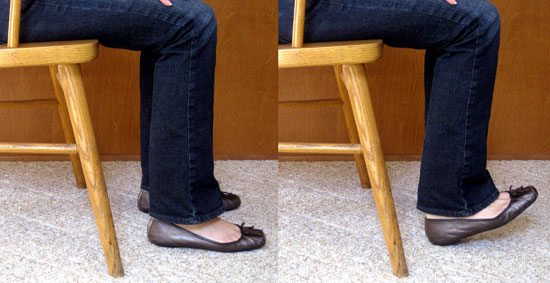
-When performing toes raises, be sure to sit on a bench or chair with knees at a 90 angle
-During toes raises, keep hands either on the chair or bench beside hips, or on thighs with palms facing up
-Be sure to keep a straight posture, tall with shoulders back and chest out
For a strong core and strong abdominals and obliques, a crunch is a great exercise. However, many people tend to do a crunch the wrong way that can cause injury to their neck and back. When doing a crunch the correct way, you are able to efficiently and effectively strengthen your core muscles in a safe way.
-walking/running
-getting out of bed
-laughing and coughing
-balancing
-picking things up/carrying objects
Things To Remember
-be sure to lift with your shoulders, bringing your shoulder blades off the ground
-to keep the chin off the chest and keep the neck in line with the spine, look at the ceiling
-keep elbows open; DO NOT bring them forward
-DO NOT interlock fingers behind the head; this will cause the neck to bend and strain
-breathe out through the mouth when lifting off the ground, and inhale through the nose when releasing back to the ground
Picture of a correct crunch Video of a correct crunch
Although it's one of the hardest exercises to do, the push-up is also one of the best. It involves using many upper body muscles and core muscles. And it also forces your lower body muscles to statically contract in order to provide stability for the body. It is an overall quick, efficient, and highly effective workout when you're in a hurry, you want to target as many muscles as possible into one exercise, or you just want to get a great upper body workout.
Muscles Used
-Pectoralis major and minor (chest)
-Anterior, Medial, and Posterior Deltoid (shoulder)
-Trapezius (upper back)
-Latissimus dorsi (lats/"bra fat")
-Biceps (front of upper arm)
-Triceps (back of upper arm)
-Abdominals (entire stomach region)
-Obliques (sides of mid-section/"lovehandles")
-Erector Spinae (mid-lower back)
Daily Use of Muscles
-picking up children/groceries
-bending/leaning forwards or backwards
-balancing
-putting food away
-cleaning, sweeping
-sitting up straight/correct posture
-driving a car
Things to Remember
-hands need to be about shoulder-width apart, maybe a bit wider
-start in the "up" position
-be sure not to let hips sag
-try not to stick hips out in the air-keep a streamline form from head to toe
-keep head in line with spine
-if starting on hands and toes is too hard, start on your knees and build up
-if starting on the ground is too intense, try doing wall push-ups
A Perfect Squat
For those of you who are wanting to work on your main lower body muscles, I recommend the basic squat. It's easy on the knees (when using correct form), it increases flexibility, and its relatively easy to do.
Muscles Used
-Gluteus Maximus, Medius, and Minimus (Buttocks)
-Quadriceps (Front of thigh)
-Hamstrings (Back of thigh)
-Iliotibial Band and other Abductors (Outer Thigh)
-Gracilis, Sartorius, and other Adductors (Inner Thigh)
Daily Use of Muscles
-stepping up stairs
-jumping
-walking/running
-getting in/out of a car
-kicking a ball
-standing up/sitting down
Things to Remember
-sit back so knees don't go past toes
-keep weight in heels, not in the toes
-bring arms in front if needed to compensate for weight distribution
-only do small squats to start;then go lower as strength progresses
-never go further than a 90 degree angle in your knees